
The data compatibility blog,
Join the discussion
ETL: Why You Cannot Trust Your Analytics Data
0 May 29, 2025

Data Transformations Cause Analytics Data Trust Issues
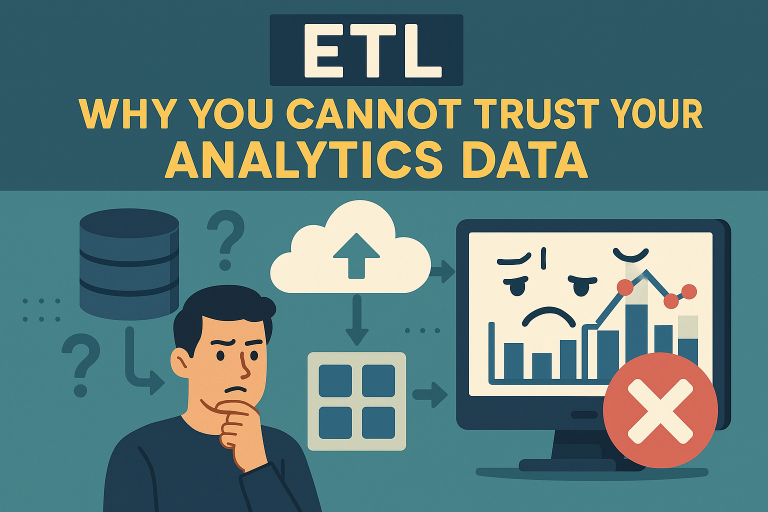
Most data used for analytics has been transformed and integrated from multiple source datasets. This data transformation process introduces inaccuracies into your analytics data. When transforming a source dataset into a target dataset, you are sure that they are not equivalent. Worse yet, both datasets are isolated silos and cannot be joined to compare or audit the results. You should not trust data that you can not directly validate. The following list provides several reasons not to trust your analytics data that has undergone data transformations:
- Fragmented Data: Data from multiple disparate sources lacks shared data integrity. Therefore, the source datasets are isolated and the data architecture is fragmented and disjointed.
- Poor Data Quality: Since data integrity is not enforced between datasets, each dataset contains a conflicting version of the data and metadata for each master data domain.
- Incomplete Data: When source datasets are ingested for data integration, they are typically ingested in part to simplify transformations and reduce workload. Incomplete dataset ingestions lead to skewed results and misinformed decisions.
- Transformation Biases: Disparate source datasets already lack data integrity between them. When these siloed datasets are first transformed and then integrated, the resulting dataset is filled with biases or distortions. These transformation biases can lead to misleading conclusions and affect the trustworthiness of the analytics.
Providing identical source datasets to ten different data teams will result in ten different integrated datasets. Beyond this, there is no way to audit or validate the data transformation, as the sources and the results are mathematically incongruent. When users familiar with the original data observe discrepancies in the integrated dataset, they lose confidence in its reliability.
Why You Can Trust Universally Interoperable Datasets
With ETL-based data integration methods, the metadata and data content of source datasets are transformed, which unintentionally corrupts the dataset. In contrast, the Object-Oriented Data Management and design approach retains the original metadata and data content of all source datasets in its unadulterated form. When modernizing the source datasets, the datasets are enriched with Data Compatibility Standards to form Universally Interoperable Datasets. As a result of modernization, the enriched datasets are universally interoperable and characterized as analytics and AI-ready modular plug-and-play datasets. These Universally Interoperable Datasets spontaneously form a Modular Data Fabric with end-to-end data integrity enforcement. Universally Interoperable Datasets can be joined and unified as needed, to validate and audit their data content within the fabric. The entire fabric conforms to FAIR data principles and is composed of trustworthy data.
Maxxphase is the sole provider of our patented methods: Compatible Data Modeling, Object-Oriented Data Management, Data Compatibility Standards, Universally Interoperable Datasets and Modular Data Fabrics. For inquiries, comments, or to discuss use cases, please don’t hesitate to contact us.