
The data compatibility blog,
Join the discussion
Data Compatibility Conforms to FAIR Data Principles
0 May 15, 2025


Universally Interoperable Datasets that Work Together in a Modular Data Fabric
In a world of disparate, siloed datasets, the FAIR data principles have emerged as critical properties to promote data sharing. To enhance the value and utility of data, your datasets must be Findable, Accessible, Interoperable, and Reusable.
Maxxphase’s patented data compatibility methods have created the first Universally Interoperable Datasets(UIDs) to replace siloed datasets. Because data integrity is enforced within and across UIDs, these UIDs serve as the foundation of our revolutionary Modular Data Fabrics. We provide a diagram of Maxxphase’s Modular Data Fabric Architecture in Figure 1. When you combine UIDs in a Modular Data Fabric, you adhere to the FAIR Data Principles, which is not possible with isolated, siloed datasets.
Our Modular Data Fabric provides seamless data continuity that we could not find in prior-art data architectures. We added UID Golden Records that significantly improve the data quality and trustworthiness of the entire Modular Data Fabric. Now, the UID Foundation Library, in combination with the UID Golden Records, becomes your Single Source of Truth. We designed this fabric to comply with FAIR Data Principles while supporting modern technologies such as AI and Knowledge Graphs.
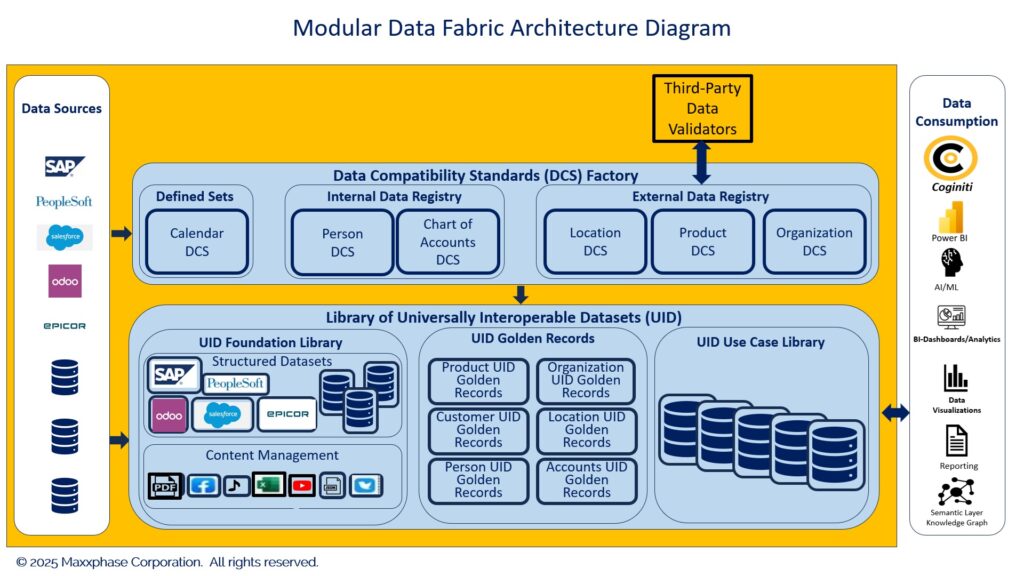
Modular Data Fabric containing a Data Compatibility Standards Factory and the Library of Universally Interoperable Datasets.
The Findable FAIR Data Principle
This FAIR principle uses metadata and persistent identifiers to ensure data can be reliably found and referenced. Siloed datasets do not share unique data record identifiers beyond the dataset. In contrast, our Data Compatibility Standards (DCS) enforce data integrity between UIDs. With DCSs as part of our Object-Oriented Data Management, we ensure that unique data record identifiers are persistent beyond individual UID.
We encapsulate each UID within a set of reusable DCSs. Each DCS represents a master data domain-specific repository of reference data instances, which includes persistent unique data record identifiers.
The repository of UID Golden Records reference data instances is named UID Golden Records, as shown in Figure 1. We can connect, on demand, the entire repository of golden reference data instances with any UIDs of the fabric. Our use of this repository of reference data removes data redundancy from the UIDs. This repository also provides a single shared source of high-quality data for the fabric. In addition, a curated metadata layer, such as a semantic layer, can exist over the entire fabric to enhance findability.
The Accessible FAIR Data Principle
The FAIR Data Principle of accessibility is a critical factor determining datasets’ usability and value. Typically, we store datasets in many different formats and environments. However, modern methods of storing and retrieving datasets exist to promote and provide dataset accessibility.
In the Modular Data Fabric Architecture of Figure 1, we designed the UID Foundation Library as a universally Interoperable data lakehouse. We encapsulate each dataset of the compatible data lakehouse within a set of DCSs. This encapsulation modularizes each dataset, making it universally interoperable with other datasets. Each UID is an integral component of the Modular Data Fabric. UIDs seamlessly unify spontaneously. Now, you can access any UID individually or in many unified combinations.
The Interoperable FAIR Data Principle
Maxxphase has developed universal dataset interoperability, which facilitates the unification of distributed datasets without requiring data transformations. UIDs collectively function indistinguishably from a single consistent dataset.
As shown in Figure 1, we built and maintained our reusable DCSs in our Data Compatibility Standards Factory. We create and maintain each DCS in a data registry of unique data instances. We use these data registries to enforce data integrity between UIDs in the Modular Data Fabric. Each UID of the Modula Data Fabric is modularized by its DCSs. Each UID interacts with other UIDs in the same established manner.
The Reusable FAIR Data Principle
DCSs are reusable in an unlimited number of UIDs. Each UID is encapsulated within a standardized data context, allowing it to be reused with any other UIDs. The compatible datasets in the Compatible Golden Records section of the Modular Data Fabric represent the single trusted source of truth for each master data domain significant to the business. Finally, the entire Modular Data Fabric is reusable with other Modular Data Fabrics based on the same Data Compatibility Standards.
Maxxphase Data Compatibility is a framework that aligns with the FAIR Data Principles to enhance data interoperability and usability. Maxxphase focuses on creating a seamless directly interoperable environment where data from various sources can be unified and utilized effectively. By adhering to standardized formats and protocols, Maxxphase ensures that data remains consistent and compatible across different systems and applications.
In Summary
The Maxxphase Modular Data Fabric is better aligned with the FAIR Data Principles than any other data architecture because its foundation datasets are universally interoperable. All other data architectures are based on isolated, disparate datasets. With Maxxphase’s patented Data Compatibility Methods, organizations can create a robust data management framework that enhances the value and utility of all their data. This approach not only facilitates data sharing and reuse but also supports the development of innovative solutions as depicted in the Compatible Use-Case Sandbox section of the Modular Data Fabric This fabric data architecture is explicitly designed to support more modern business technologies such as AI/ML, semantics, and Knowledge Graph.
In conclusion, the FAIR Data Principles and Maxxphase Data Compatibility represent a powerful combination for modern data fibric management. By making data Findable, Accessible, Interoperable, and Reusable, organizations can unlock the full potential of their data while also sharing data with other organizations.