
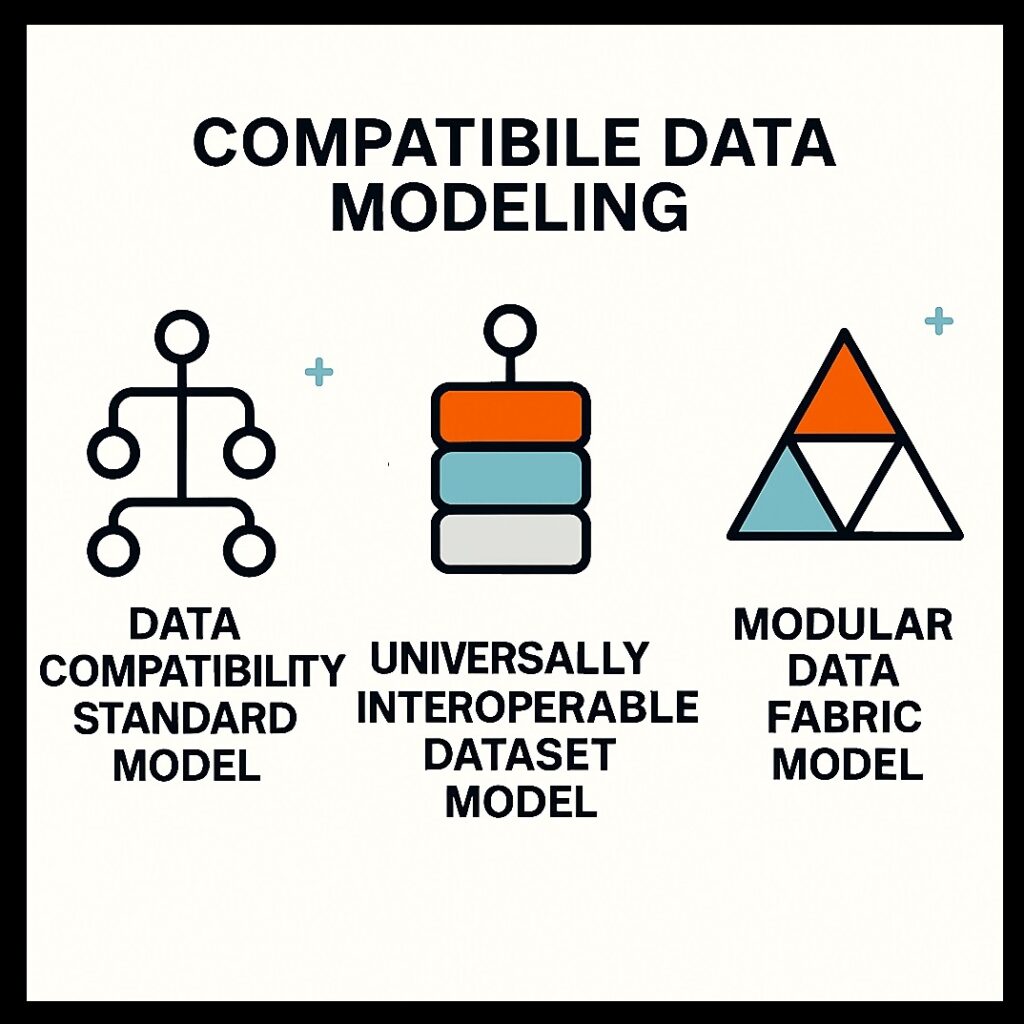
Maxxphase Does Compatible Data Modeling
Compatible Data Modeling is an enhancement of traditional data modeling, in which data models are now modular with plug-and-play capabilities. As such, compatible data models can be linked as component models of larger data objects. Compatible Data Modeling is used to design:
- Reusable Data Compatibility Standard Entities
- Universally Interoperable Datasets from Your Source Datasets
- Universally Interoperable Dataset for Enhancing Your Modular Data Fabric.
Compatible Data Modeling becomes the design foundation for implementing Object-Oriented Data Management and Governance into our datasets and fabrics.
Traditional Data Modeling
Traditional data modeling methods were developed in the 1970s. The original conceptual, logical, and physical normalized data models remain to this day. Dimensional data modeling was added in the late 1980s to support the development and implementation of data warehouses. Other data modeling styles were introduced, with the most popular style being the data vault model.
With each of these traditional data modeling styles, there was never data integrity enforced between physical data models. When traditional data models are instantiated, the resulting datasets are always disparate data silos. These disparate datasets are characterized as data silos because they cannot be joined to share data directly with other datasets.
Maxxphase developed Compatible Data Modeling to fix this data silo problem and to produce Universally Interoperable Data Models. Universally Interoperable Data Models are self-contained data models designed to be plug-and-play. As such, Universally Interoperable Data Models can be combined to form a data model of a Modular Data Fabric. Using Compatible Data Modeling, an entire data architecture can now be modeled.

Compatible Data Modeling
Compatible Data Modeling is an enhanced data modeling style that focuses on creating and maintaining universally interoperable data models - data models that can be joined and unified. Datasets and data fabrics instantiated from Compatible Data Models are themselves universally interoperable.
Compatible Data Modeling is a relatively straightforward enhancement of traditional data modeling. Compatible data modeling uses new data modeling objects and Object-Oriented Data Management and design methods to support the design of Data Compatibility Standards, Universally Interoperable Datasets, and Modular Data Fabrics. The new data modeling objects for logical data models are:
- Data Compatibility Standard entities that are master data domain-specific data entities that support universal interoperability. These data entities are reused in multiple data models to provide the commonality needed to join and unify them.
- Peer Entity Relationships that relate copies of the same Data Compatibility Standard objects from multiple data models.
Compatible Data Models are universally interoperable because of the embedded Data Compatibility Standards data entities. Compatible Data Models also features plug-and-play functionality inherited from the Peer Entity Relationships. As such, these compatible data models can be combined or separated as needed. In fact, the entire Modular Data Fabric can be modeled as a set of components using Compatible Data Models.
Data Compatibility Standard entities are new data modeling objects that serve as the universal interface for every compatible data model. The Data Compatibility Standard entities are designed as a non-invasive add-on to encapsulate traditional data models. These standard data entities modularize any data model, adding the metadata commonality needed for Universally Interoperable Datasets instantiated from compatible data models.
A new peer entity relationship has been defined to dynamically join an unlimited number of Data Compatibility Standard entities across compatible data models. Data integrity enforcement for the peer entity relationships is a patented master data management-type method. This data integrity enforcement among compatible datasets ensures that compatible datasets will be dynamically plug-and-play.
When datasets are instantiated from compatible data models, these datasets are compatible modular plug-and-play. Compatible datasets can be blended on demand to provide whatever data and information is required.