
Maxxphase Does Universally Interoperable Datasets
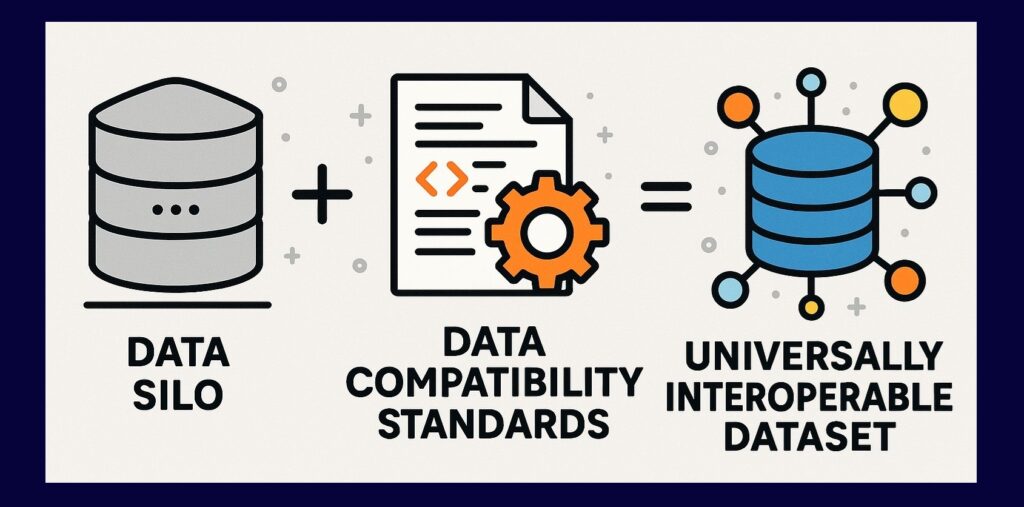
We use our patented Data Compatibility Standards to enrich any dataset silo, creating a Universally Interoperable Dataset. We do not touch your data and metadata, as the Data Compatibility Standards form a wrapper that encapsulates your original dataset. Universal interoperability among datasets is achieved through the Data Compatibility Standards. Beyond interoperability, the standards are also enhancing each dataset's behavior and functionality, including making the dataset both analytics- and AI-ready.
What are Universally Interoperable

Datasets?
Universally Interoperable Datasets are datasets that can be joined and have their data unified on demand. They are a class of Maxxphase's Object-Oriented Data Objects, with each data object in this class being a dataset encapsulated within a set of Data Compatibility Standards. Each Universally Interoperable Dataset inherits the collective Metadata, Data Content, and data functionality from the set of Data Compatibility Standards that encapsulate it.
In Compatible Data Modeling, the Universally Interoperable Dataset is modeled as a Compatible Data Model - a modular data model with plug-and-play connectivity to other Compatible Data Models. An existing data model can be enriched with a set of different Data Compatibility Standard data entities to form the Compatible Data Model. Each master data domain of the data model corresponds to a single Data Compatibility Standard. When instantiated in a database, the Universally Interoperable Dataset is created.
Each Universally Interoperable Dataset is designed to:
- Enforce dataset security and grant accessibility as required.
- Maintain local dataset ownership, governance, and compliance.
- Adhere to data standards for global mathematical consistency.
- Optimize query performance and capacity.
- Be both Analytics and AI/ML Ready.
- Exist on a software platform and server that supports connectivity.
When the Data Compatibility Standards encapsulate a Universally Interoperable Dataset, the dataset is modularized, and its complexity is abstracted or hidden by the standardized interface. In addition, the standardized data functionality of each Data Compatibility Standard is inherited by each Universally Interoperable Dataset.
Universally Interoperable Datasets spontaneously form a Modular Data Fabric in which all data is directly accessible and can be combined dynamically on demand. Any Universally Interoperable Datasets can be added to the fabric without disruption and interface immediately with any other fabric datasets.
Business Advantages of Universally Interoperable Datasets
Universally Interoperable Datasets offer massive business advantages, including breaking down data silos for holistic insights, boosting efficiency, and cutting costs with Object-Oriented Data Management, enabling faster, better decisions, fostering innovation through seamless collaboration, increasing agility for market changes, and ensuring stronger compliance and security across platforms, driving digital transformation and competitive edge.
Key Business Advantages:
- Retained Data Ownership & Security: Data access and protection established by the dataset owner without the need to move or copy the data.
- Improved Efficiency & Cost Savings: Reduces duplication, streamlines operations, and cuts costs associated with data reconciliation and manual handling. Our Standards-Based dataset interoperability does not use expensive, complex, customized ETL or data exchange software.
- Enhanced Decision-Making: Provides a unified, 360-degree view of data, enabling more accurate, informed, data-driven strategic decisions.
- Greater Agility & Innovation: Quickly adapt to new demands, integrate new systems, and foster innovation by enabling real-time data sharing and analysis across departments and with partners.
- Better Collaboration & Alignment: Breaks down silos, allowing stakeholders to access and share data seamlessly, promoting organizational unity and collective problem-solving.
- Holistic Insights & Performance: Enables comprehensive analysis, trend identification, and benchmarking across industries, leading to more robust products and services.
- Scalability & Future-Proofing: Creates a flexible, Modular Data Fabric that can easily scale and seamlessly incorporate new datasets without disruption.
- Stronger Governance & Compliance: Simplifies regulatory adherence by ensuring consistent data quality, security, and governance across different systems and jurisdictions.
In essence, universal interoperability turns disconnected data into a strategic asset, unlocking growth potential, reducing risk, and delivering superior market performance.