
Maxxphase Does Modular Data Fabrics
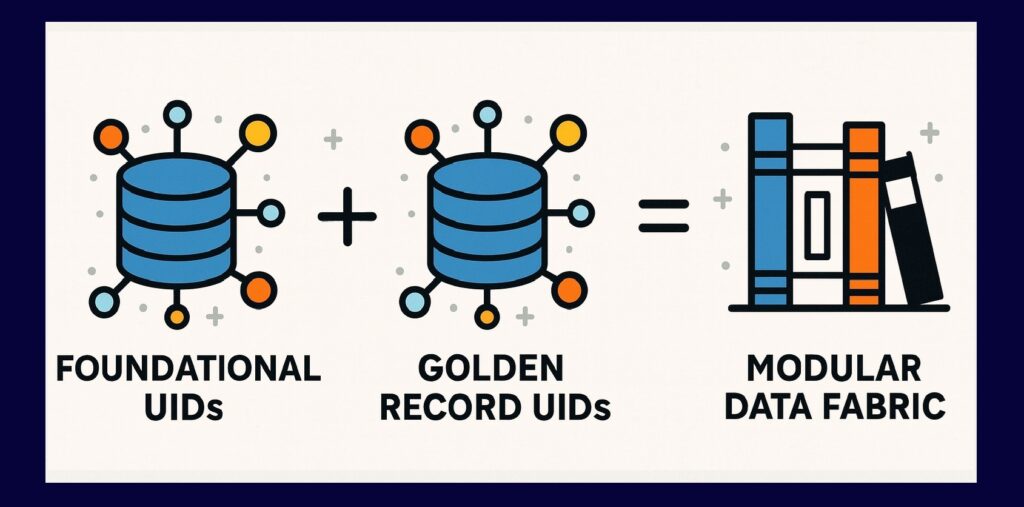
We design and implement Modular Data Fabrics as a repository to build upon the solid data foundation formed by the collection of source Universally Interoperable Datasets - Your Single Source of Truth. Specifically, we want to provide the highest-quality data foundation possible to support AI and business intelligence. With the addition of Golden Records Universally Interoperable Datasets, an enterprise view of data is shared into the fabric.
Your Modular Data Fabric is, by far, the most advanced data architecture available today.
What is a Modular Data Fabric?
 A Data Fabric is a data architecture that ensures comprehensive, end-to-end data integrity, which eliminates dataset silos. A Modular Data Fabric is a new style of data fabric composed of multiple Universally Interoperable Datasets (UIDs) as opposed to the traditional monolithic data fabric style. The Modular Data Fabric is an object-oriented data management class that inherits all metadata, data content, and data functions from component UIDs and their component Data Compatibility Standards. Each UID freely and seamlessly shares data with other UIDs, and the fabric serves as the organization's Single Source of Truth.
The Modular Data Fabric is typically designed, implemented, and maintained by a single organization. However, the Modular Data Fabric is also extensible, as it is Universally Interoperable with other organizations' Modular Data Fabrics that use the same Data Compatibility Standards. Therefore, Universal Interoperability can be extended across organizations and industries as needed, provided appropriate access and security permissions are granted.
Golden Data Records for High-Data Quality
 Specialty UIDs can be added to the Modular Data Fabric to enhance its shared functionality. For example, a customer-centric Golden Records UID can be added to the fabric and shared with all UIDs that reference customer information. Separate Master Data domain-centric Golden Records UIDs can also be added to the fabric to improve the data quality of that master data domain. The Golden Records UIDs provide high-quality data shared by all UIDs in the fabric.
Use Case Library for Materialized Project-Based Datasets
Specialty UIDs can also be materialized and stored in the Modular Data Fabric for specific business use cases. Their use-case-specific UIDs are typically derived from multiple foundational UIDs to deliver high-performance, subject-specific data with enhanced security. These use-case UIDs can be used for KPIs, as a training dataset for ML, or as specific AI-ready datasets. Use case-specific UIDs remain universally interoperable with other UIDs, including other specialty UIDs.
Never before has a business had such informational power at its fingertips. The Modular Data Fabric provides a single source of consistent and trusted, instantly available data. Within the data fabric, each Universally Interoperable Dataset forms direct links with every other Universally Interoperable Dataset. These dataset links are the weave of your Modular Data Fabric. The fabric provides a 360ᴼ view of all your data.
(Click Image Below for Modular Data Fabric Details)
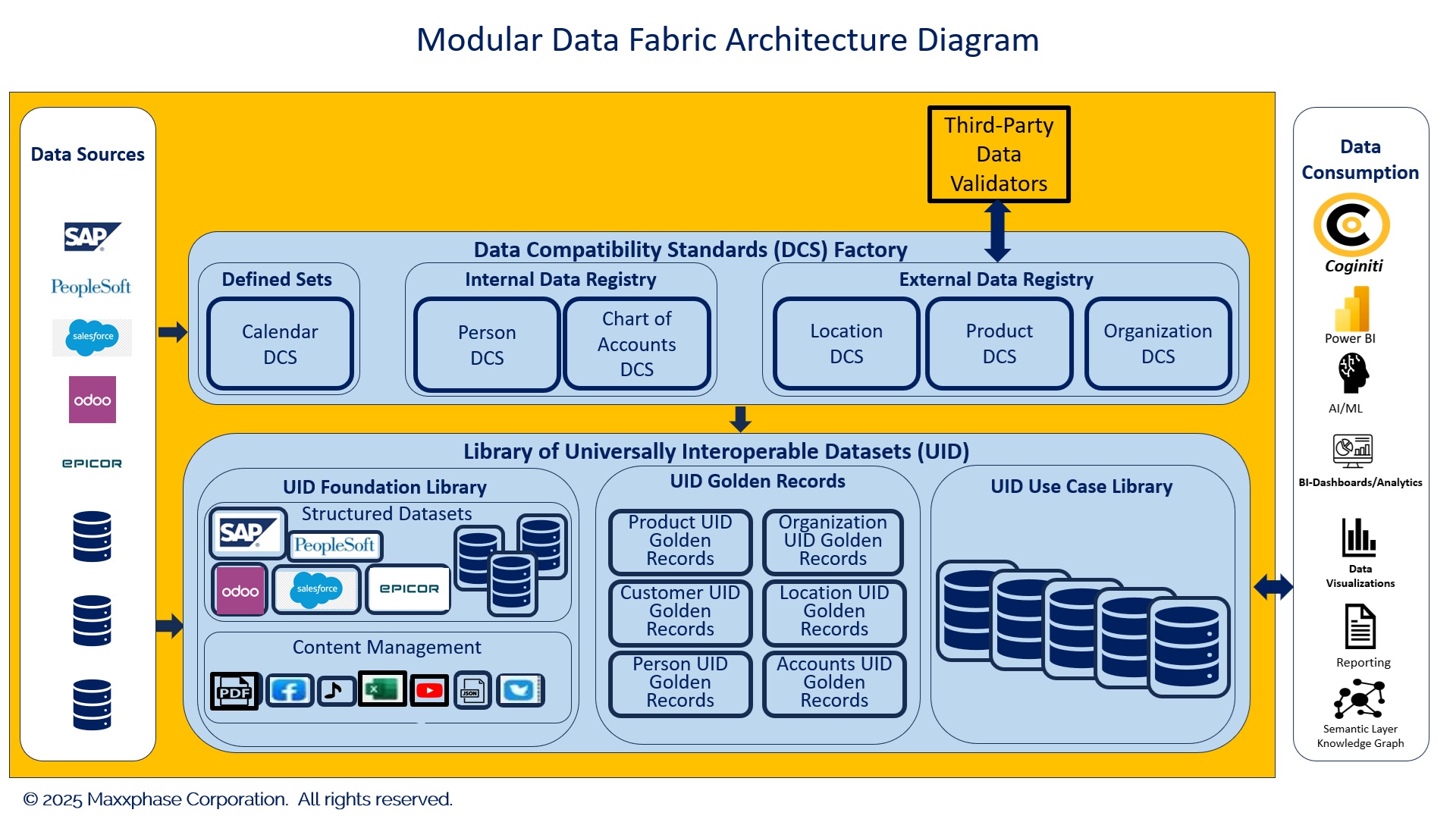
The Modular Data Fabric with the Data Compatibility Standards Factory and the Library of Universally Interoperable Datasets.
Business Advantages of Modular Data Fabrics
Modular Data Fabrics offer significant business advantages by inheriting the advantages of Data Compatibility Standards and Universally Interoperable Datasets. Beyond the inherited business advantages, the modular data fabric adds the following advantages by enabling:
- A Single Source of Truth as a data foundation for your organization.
- Delivering unparalleled, high-quality data.
- Universally Interoperable Data Sharing throughout and between organizations.
- Enterprise-wide Object-Oriented Data Governance and Stewardship.
- Seamless AI/ML-ready Data and Advanced Business Intelligence.
- Cost savings and rapid ROI due to reduced complexity and maintenance.
- Decentralized, flexible, scalable, reliable, future-proofed, data architecture featuring localized data security and retained dataset ownership.
Operational Efficiency and Cost Savings
- Universal Dataset Interoperability: All datasets designed for universal interoperability connect using identical standards. Customized dataset interfaces or software conversions are not used. Instead, each standard interface is based on the Data Compatibility Standards, allowing for flexible use through polymorphism.
- Extensible: Universally Interoperable Datasets may be incorporated into the fabric and seamlessly interact with all existing datasets without causing disruption. By leveraging reusable Data Compatibility Standards, organizations can integrate new systems and technologies more efficiently, thereby minimizing development costs and accelerating time-to-market.
- Reduced operational costs: By eliminating redundant procedures and minimizing manual data wrangling, businesses can achieve significant cost savings.
- Decentralized Design-Based Solution: Standards-Based dataset interoperability does not use expensive, complex customized ETL or data exchange software.
Improved Decision Making and Collaboration
- High-Quality Single Source of Truth: Golden Data Records are incorporated into the Modular Data Fabric to improve and maintain high-quality data. All data of the fabric is available on demand for audits and verifications to ensure a single version of the truth. Insights derived from the data are entirely traceable back to the data foundation for justification.
- AI/ML-Ready Data Delivery: Standardized Plug-and-Play Universally Interoperable Datasets that feature end-to-end data integrity, enhanced with Single Source Golden Data Records, provide the best data foundation for AI and ML. No complex data wrangling is required, as the fabric is explicitly designed to support AI.
- Analytics-Ready Data Delivery: From the Data Compatibility Standards, data warehouse functionality is inherited into each Universally Interoperable Dataset. Since the datasets are Universally Interoperable, any combination of data can be created dynamically or materialized with full data warehouse functionality and direct access to Golden Data Records. Again, no complex data wrangling is required.
- Better Data Consistency Delivers Collaboration: Reusable Data Compatibility Standards ensure master data commonality throughout the organization as well as across organizations. The Modular Data Fabric can be a federated, distributed data architecture that joins and shares data across multiple organizations as needed.
Agility, Innovation, and Compliance
- Dataset Modernization: Any existing dataset can be enriched rapidly with Data Compatibility Standards to become a Universally Interoperable Dataset. Datasets are added to the fabric instantly without disruption and are immediately interoperable with all other datasets.
- Object-Oriented Inheritance: Organizations can quickly incorporate changes or additions into one Universally Interoperable Dataset that is now shareable to all data in the fabric.
- Changing Requirements and Use Cases: Organizations can quickly adapt to changing market conditions, new business needs, and regulatory requirements by materializing specialty Universally Interoperable Datasets specific to any changing requirements and use cases.