
Maxxphase Does Object-Oriented Data Management & Design
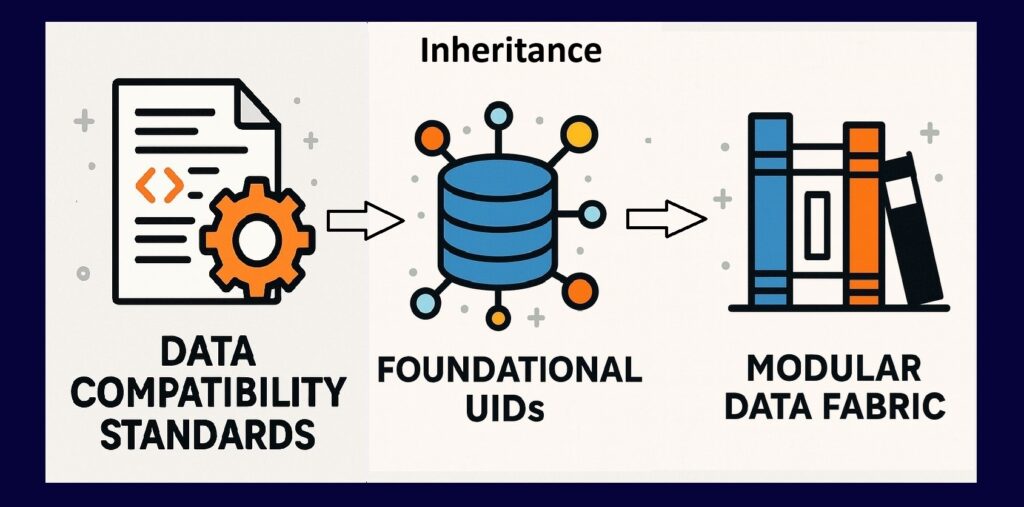
Object-Oriented Data Management is essential to creating and maintaining Universally Interoperable Data. The object-oriented paradigm of encapsulation, modularization, and inheritance is a powerful combination for implementing the proper data governance compliance within our data objects. Data Compatibility Standards are the lowest-level object class. Among its behaviors are enforcement of data integrity. When Data Compatibility Standards are inherited, universal interoperability behaviors are embedded into both the Universally Interoperable Datasets class and the Modular Data Fabric class.
What is Object-Oriented Data Management?
Object-oriented data management is a paradigm for storing, organizing, and manipulating data as "data objects"—self-contained units that bundle metadata, data content, and data behaviors. Object-Oriented Data Management is based on the same fundamentals as Object-Oriented Programming: abstraction, encapsulation, inheritance, and polymorphism.
In Data Compatibility, we have three data object classes:
-
- Data Compatibility Standards, which are the lowest level of the data object classes. Data Compatibility Standards operate at the data structure and data content tier. In part, these data objects encapsulate datasets to standardize their interfaces for joining and enforce data integrity across datasets.
- Universally Interoperable Datasets, which are the second-tier of data object classes as they inherit encapsulated data functions from the Data Compatibility Standards. Beyond the inherited behaviors, these dataset objects implement data access control, dataset protection, and retain dataset ownership.
- Modular Data Fabrics, which are the highest-tier of data object classes, as they inherit data functionality from both the Data Compatibility Standards and the Universally Interoperable Datasets. Modular Data Fabrics occur at the data architecture tier. In part, the fabric data object enhances fabric data quality by providing shared Golden Data Record Datasets as a foundation for a single source of truth.
Business Advantages of Object-Oriented Data Management
Maxxphase's Object-Oriented Data Management and Design offer businesses advantages such as faster development & lower costs through reuse, increased productivity, better scalability, and maintainability.
Key Business Advantages:
- Data Object Reusability: Use inheritance to add to existing data objects, reducing repetitive work and accelerating development, thereby lowering costs substantially.
- Modularity & Collaboration: Break large datasets and data architectures into self-contained objects that teams can work on independently.
- Scalability & Extensibility: Easily add new features or handle more data by extending existing data object classes without disrupting the whole system, crucial for growing your business.
- Security & Data Integrity: Encapsulation hides complex internal data, protecting it from unintended access and ensuring data remains secure.
- Easier Maintenance & Upgrades: Well-defined data objects make it simpler to locate and remediate issues or implement updates, as changes in one object have minimal impact on others.
- Real-World Problem Solving: Models real-world entities directly in reusable data objects, making complex systems easier to understand and manage.
- Flexibility: Polymorphism allows objects to take on many forms, enabling flexible designs that adapt to changing requirements.
By leveraging Object-Oriented Data Management, businesses create robust, adaptable, and cost-effective Modular Data Fabrics that can evolve with their strategic goals, providing a significant competitive edge.
The Secret of Universal Interoperability
Maxxphase Data Compatibility brings standardization to dataset and data architecture design and development methods. Our Object-Oriented Data Management and Design standards define target states to ensure compatibility across all Universally Interoperable Datasets and Modular Data Fabrics. Universal interoperability of datasets and data fabrics is an inherited feature that stems from our Data Compatibility Standards. When our Data Compatibility Standards non-invasively encapsulate a dataset, that dataset becomes universally interoperable. When Universally Interoperable Datasets compose a Modular Data Fabric, the fabric is also universally interoperable with other Modular Data Fabrics.
Our Data Compatibility Standards are designed to enable reliable, plug-and-play data access paths between Universally Interoperable Datasets and Modular Data Fabrics. These data access paths allow the computer to make the appropriate direct data record matches to join datasets. In this way, any data from any Universally Interoperable Dataset may now be directly joined with the data of any other Universally Interoperable Datasets. The Maxxphase Data Compatibility Standards are the secret behind universal interoperability.