From Data Silos to Universally Interoperable Datasets

Maxxphase Data Compatibility is an Object-Oriented Data Management Strategy that focuses on abstraction, encapsulation, inheritance, and polymorphism to deliver whatever is required in a data ecosystem. Data Compatibility is a design-based methodology rather than a software-based one. Data Objects are designed and implemented without requiring complex data transformations or layered data architectures. We focus on designing data objects that are standardized, reusable, modular, and interoperable. These data objects can be used within an organization, across organizations, and throughout an industry.

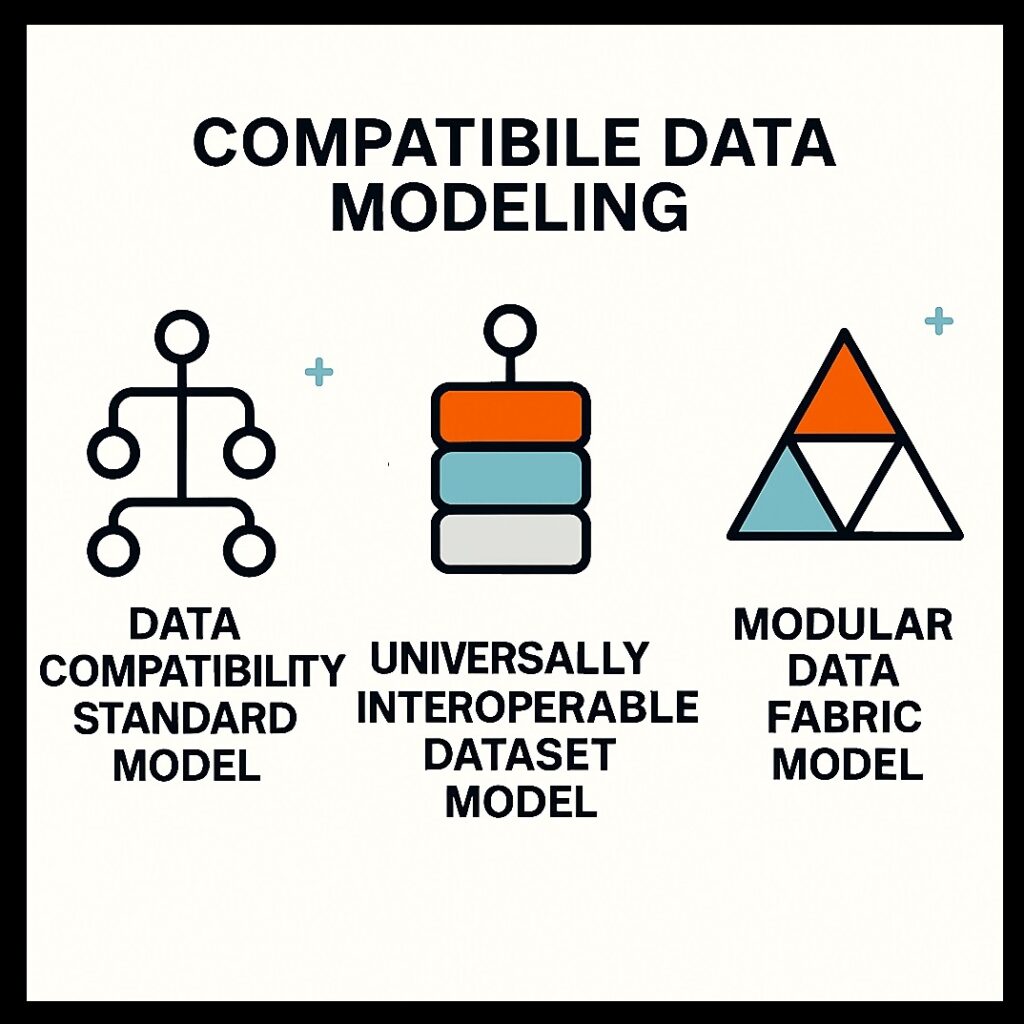
We use Compatible Data Modeling, an enhancement to traditional data modeling, to design and implement  these classes of data objects:

    1. Data Compatibility Standards, where each is a master data domain-specific data entity designed for reuse in many Compatible Data Models. The Data Compatibility Standard is our lowest-level data object.
    2. Universally Interoperable Datasets, where each dataset is modularized by encapsulation within a group of Data Compatibility Standards. Each modularized dataset, as designed, is self-contained and provides a universal plug-and-play interface for dynamic interaction with other datasets.  The dataset inherits the metadata, data content, and functionality from each Data Compatibility Standard that encapsulates the dataset. One reusable Data Compatibility Standard data entity is included in the dataset model for each master data domain in the Compatible Data Model.
    3. Modular Data Fabric is a seamless data fabric composed of multiple Universally Interoperable Datasets, where dataset's data access, security, and ownership are inherited from each Universally Interoperable Dataset. Specialty Universally Interoperable Datasets are added to the fabric to improve overall data quality and to create a Single Source of the Truth for the organization.

Each Universally Interoperable Dataset can be added or removed from the Modular Data Fabric without impact to other datasets. Since the datasets are universally interoperable, data can be combined on demand from any combination of datasets. All your data is directly accessible, auditable, and your derived insights are justifiable. In the data fabric, all your datasets now work together because end-to-end data integrity is enforced. 

The Secret of Universal Interoperability

Maxxphase Data Compatibility brings standardization to dataset and data architecture design and development methods. Our Object-Oriented Data Management and Design standards define target states to ensure compatibility across all Universally Interoperable Datasets and Modular Data Architectures. Universal Interoperability of datasets and data architectures is an inherited feature that stems from our Data Compatibility Standards. When our Data Compatibility Standards non-invasively encapsulate a dataset, that dataset becomes universally interoperable. When Universally Interoperable Datasets compose a Modular Data Architecture, the Modular Data Architecture is also Universally Interoperable with other Modular Data Architectures.

Our Data Compatibility Standards are designed to enable reliable, plug-and-play data access paths between Universally Interoperable Datasets and Modular Data Architectures. These data access paths allow the computer to make the appropriate direct data record matches to join datasets. In this way, any data from any Universally Interoperable Dataset may now be directly joined with the data of any other Universally Interoperable Datasets. The Maxxphase Data Compatibility Standards are the secret behind Universally Interoperability.


Analytics-Ready Data Compatibility Standards

At Maxxphase, we designed and developed Data Compatibility Standards to incorporate a data warehouse's functionality. When Maxxphase Data Compatibility Standards enrich a dataset, that compatible dataset now supports multi-dimensional analytics. In addition, any compatible dataset has the direct data interoperability needed to blend with any other compatible dataset. These interoperable compatible datasets become Compatible Data Warehouse plug-and-play modules. These modules are interchangeable and can be dynamically blended to form more business-relevant Compatible Data Warehouse modules. Consolidated data warehouse modules can be virtual or materialized to create a Compatible Data Warehouse.

Any dataset, structured, semi-structured, or unstructured may be made compatible. When a source dataset is standardized, it becomes a real-time data warehouse module. However, a compatible dataset may also be restructured to support a near real-time data warehouse component. In either event, these modular datasets will all be compatible, integrated, directly interoperable, and analytics-ready. Our patented analytics-ready modular plug-and-play datasets are far superior to the disparate datasets that are predominant in IT today.

The Modular Data Fabric as a Data Architecture

For many organizations, the ultimate data architecture is a data fabric. However, attempting to construct a monolithic data fabric using conventional data transformation-based methods is ridiculously difficult and expensive. 

The Compatible Data Fabric is composed of directly interoperable, analytics-ready, modular datasets. When a dataset is made compatible, it automatically becomes an integral component of the Compatible Data Fabric. Since compatible datasets are directly interoperable, there are no data movements and no data transformations required! Each compatible dataset is plug-and-play within the Compatible Data Fabric.

Compatible datasets are each encapsulated with a "shell" composed of Maxxphase Data Compatibility Standards. These dataset shells are designed and implemented to form a multitude of data access paths or threads that dynamically blend compatible datasets. This dataset blending creates a virtual analytics-ready compatible data fabric. All interactions among compatible datasets are identical and dynamic. As such, compatible datasets are designed to be additive.  The Compatible Data Fabric will revolutionize digital data, information, and knowledge in the IT industry.